
Blog
Why Do I Still Have a Double Chin After Losing Weight? | Albuquerque

Why Do I Still Have a Double Chin After Losing Weight?
You worked hard to lose the weight. Your clothes fit differently, your body has changed, and you may feel healthier and more confident—but then you look in the mirror and notice something frustrating:
You still have fullness underneath your chin.
If this sounds familiar, you’re not alone.
A double chin isn’t always simply a matter of being overweight. Genetics, aging, facial structure, skin elasticity, and localized fat can all contribute to fullness beneath the chin. Some people continue to have submental fullness even when they’re at or near their goal weight.
Weight loss can also create a different concern: looser skin around the face, jawline, and neck. Significant or rapid weight loss may reduce volume while leaving skin that doesn’t completely retract to its previous shape.
So what can you do when you’ve accomplished the weight loss but aren’t seeing the definition you want?
One option worth discussing with a qualified provider is QuantumRF™ Face by InMode, a minimally invasive radiofrequency treatment designed to support soft-tissue contraction and facial and neck contouring.
At Health Horizons in Albuquerque, we use consultations to determine whether QuantumRF may be appropriate for your specific anatomy, concerns, and goals.
Why Can You Still Have a Double Chin After Losing Weight?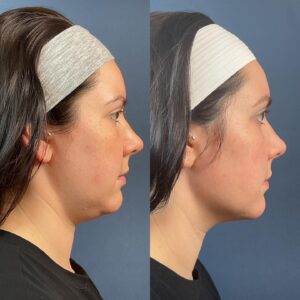
There isn’t one reason everyone develops fullness beneath the chin.
1. Stubborn localized fat
Weight loss generally reduces body fat, but it doesn’t necessarily remove fat from every area equally.
Some people naturally store more fat beneath the chin. Genetics can play a role, which means you may have submental fullness even if you’re not overweight.
This can be particularly frustrating when you’ve already changed your diet, exercise routine, or weight-loss program and the area underneath your chin hasn’t changed as much as you’d hoped.
2. Loose skin after weight loss
Losing weight is an accomplishment—but when skin has been stretched over time, it may not completely tighten afterward.
The amount of loose skin can depend on factors including your age, genetics, how much weight you’ve lost, and how long your skin was stretched.
This can create the appearance of a double chin even when there isn’t a significant amount of remaining fat.
3. Aging and changes in skin elasticity
As we age, changes in collagen, elastin, facial fat distribution, and skin elasticity can affect the jawline and neck.
The result can be less definition around the lower face, jowls, or fullness beneath the chin.
4. Your natural facial structure
Sometimes, a softer jawline simply comes down to genetics and anatomy.
The shape of your chin, jaw, neck, and the way your facial tissues are naturally distributed can all influence how defined your profile appears.
Weight Loss Doesn’t Always Equal Facial Contouring
This is an important distinction.
Weight loss and facial contouring aren’t necessarily the same thing.
You can lose significant weight and still have:
- Fullness underneath the chin
- A less-defined jawline
- Loose skin around the neck
- A softer lower-face appearance
- Localized fat that didn’t respond the way you expected
- Changes in skin firmness after weight loss
That’s why some people seek a contouring treatment after reaching their weight-loss goals.
The goal isn’t necessarily to lose more weight.
The goal may be to address a specific area that isn’t responding to overall weight loss.
What Is QuantumRF?
QuantumRF by InMode is a minimally invasive radiofrequency technology designed to deliver controlled RF energy beneath the skin to support soft-tissue contraction. InMode describes QuantumRF as a technology for procedures where soft-tissue contraction is needed, with customizable treatment based on individual anatomy.
Learn more about QuantumRF from InMode
Unlike treatments that simply focus on the surface of the skin, QuantumRF is designed to work in deeper tissue layers.
For appropriately selected patients, this can make it an option to discuss when the concern involves a combination of localized fullness and skin laxity.
Can QuantumRF Help With a Double Chin?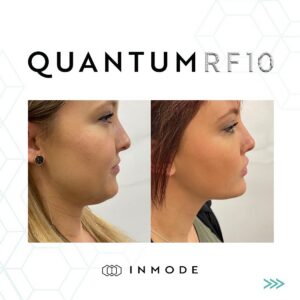
QuantumRF may be considered when the appearance of the lower face or neck is influenced by localized fullness and/or skin laxity.
The treatment is designed to provide controlled radiofrequency energy to subdermal tissue and promote soft-tissue contraction.
The important part is that not every double chin is the same.
One person may primarily have excess fat.
Another may have loose skin after weight loss.
Someone else may have a combination of both.
Your treatment plan should take those differences into account.
At Health Horizons, QuantumRF Face can be discussed as part of an individualized facial contouring plan rather than assuming every patient needs the same treatment.
What If I Lost Weight With Semaglutide or Tirzepatide?
This is becoming an increasingly common question.
Medications such as semaglutide and tirzepatide can help eligible patients achieve significant weight loss. But when a person loses a substantial amount of weight, changes in facial and neck volume can sometimes become more noticeable.
Cleveland Clinic notes that rapid weight loss can contribute to changes such as decreased facial fat, loose skin, and changes around the cheeks, jaw, and neck.
This doesn’t mean you should avoid weight loss or that everyone taking a GLP-1 medication will experience these changes.
It simply means that your face and body don’t necessarily lose volume in the exact same way or at the same rate.
For some patients, the next step after weight loss isn’t losing more weight.
It may be addressing skin laxity or localized areas of fullness that remain.
What About Loose Skin Under the Chin?
This is where choosing the right treatment matters.
If your concern is primarily loose skin, simply reducing volume isn’t necessarily the answer. In fact, removing volume without considering skin laxity can sometimes make looseness more apparent.
That’s why a consultation is important.
QuantumRF‘s radiofrequency technology is designed for soft-tissue contraction, making it an option to discuss when skin firmness is part of the concern.
The goal is to evaluate the whole area rather than treating the double chin as simply a pocket of fat.
Can You Have QuantumRF During Your Weight-Loss Journey?
Potentially, but timing matters.
If you’re actively losing a significant amount of weight, your face and neck may continue to change as your weight changes.
For some patients, it may make sense to wait until their weight has stabilized. For others, treatment may be considered earlier depending on their individual concerns and goals.
There isn’t a universal timeline.
During your consultation, your provider can discuss whether now is an appropriate time to address your jawline and neck or whether waiting would produce a more predictable treatment plan.
QuantumRF vs. Surgery for a Double Chin
For some patients, surgical procedures such as liposuction, a neck lift, or other forms of surgical contouring may be appropriate.
For others, a minimally invasive approach may be preferable.
The right choice depends on factors such as:
- Amount of localized fat
- Degree of skin laxity
- Skin elasticity
- Facial anatomy
- Overall health
- Desired degree of change
- Tolerance for downtime
- Whether you’re looking for a surgical or minimally invasive option
Cleveland Clinic notes that double-chin surgery can address excess fat and loose skin, while nonsurgical or minimally invasive options may be appropriate for selected patients.
The goal isn’t to find the most aggressive treatment.
It’s to find the appropriate treatment for your anatomy and goals.
What Is Recovery Like With QuantumRF?
One of the reasons minimally invasive treatments appeal to patients is the potential for less downtime compared with surgery.
InMode describes QuantumRF as a minimally invasive technology that does not require a surgical suite and is designed with shorter downtime in mind.
However, minimally invasive does not mean zero recovery.
Your actual recovery experience can vary depending on the treatment area, treatment settings, individual healing, and whether other procedures are performed.
Your provider will explain what to expect before your treatment, including activity restrictions and aftercare.
Who Might Consider QuantumRF Face?
You may want to discuss QuantumRF with a provider if you’re bothered by:
✔️ Persistent fullness beneath the chin
✔️ A less-defined jawline after losing weight
✔️ Localized fullness that hasn’t responded to weight loss
✔️ Loose or lax skin around the neck
✔️ Changes in facial contour associated with aging
✔️ Skin laxity following weight loss
✔️ A desire for facial contouring without traditional surgery
QuantumRF isn’t right for everyone, and results vary from person to person.
A consultation is the best way to determine whether it fits your individual needs.
Why Treat the Jawline After Weight Loss?
There’s something important that often gets overlooked during a weight-loss journey:
Your goal isn’t necessarily just a lower number on the scale.
It’s how you feel in your body.
For many people, reaching their goal weight reveals areas they didn’t notice before. You may love your weight-loss results but still feel frustrated by the appearance of your jawline or neck.
That’s not a failure.
It’s simply a different concern that may require a different approach.
And that’s where facial contouring can become part of the conversation.
QuantumRF Face in Albuquerque, NM
If you’re in Albuquerque and have lost weight but are still dealing with stubborn fullness under your chin, a less-defined jawline, or loose skin, Health Horizons offers QuantumRF Face as part of our advanced medical aesthetics services.
QuantumRF uses radiofrequency technology designed to support soft-tissue contraction and can be customized based on your anatomy and treatment goals.
Our team can evaluate whether your concerns are primarily related to fat, skin laxity, or a combination of factors and help you understand which options may be appropriate.
Ready to find out what’s possible?
Schedule a consultation with Belinda Mori, CNP, or Teal Peck, PA, at Health Horizons in Albuquerque.
You don’t necessarily need to lose more weight to feel better about your profile.
Sometimes, it’s about addressing the one area that didn’t change the way you expected.
Your weight-loss journey changed your body. Now, let’s talk about how to help you feel confident in the results.
📍 Health Horizons
4801 McMahon Blvd NW, Unit 101
Albuquerque, NM 87114
Frequently Asked Questions
Why do I still have a double chin if I’m not overweight?
A double chin can be influenced by genetics, aging, facial anatomy, and localized submental fat. Some people have fullness beneath the chin even when they are not overweight.
Can weight loss cause loose skin under the chin?
Yes. Significant weight loss can leave some people with loose skin because stretched skin may not completely return to its previous shape.
Is QuantumRF a surgical procedure?
QuantumRF is a minimally invasive radiofrequency technology. InMode states that a surgical suite is not required for the procedure, but treatment involves delivery of RF energy beneath the skin and should be performed by an appropriately trained medical provider.
How does QuantumRF work?
QuantumRF delivers controlled, pulsed bipolar radiofrequency energy to subdermal tissue. The technology is designed to support soft-tissue contraction and can be customized according to individual anatomy.
Is QuantumRF right for everyone with a double chin?
No. Double-chin concerns can have different causes, including fat, skin laxity, aging, and anatomy. A consultation is necessary to determine whether QuantumRF is an appropriate option.
How soon can I have treatment after losing weight?
There is no single timeline that applies to everyone. If you’re continuing to lose a significant amount of weight, your provider may recommend considering how ongoing weight changes could affect your treatment plan.
Related Posts

Morpheus8 & Lumecca Albuquerque | Glow & Sculpt Special
-
Posted by
annmarie

QuantumRF Body Contouring Albuquerque | October Special Health Horizons
-
Posted by

ApexRF Albuquerque | Men’s Wellness & Circulation Treatment
-
Posted by

Drop-Dead Gorgeous Open House | Health Horizons Albuquerque
-
Posted by

The Best InMode® Treatments of 2026
-
Posted by

Bioidentical Hormone Replacement Therapy (BHRT)
-
Posted by
Morpheus8 vs. Microneedling: Which Is Right for You? | Albuquerque
-
Posted by


Obagi NU-GEN Cellular Renewal Serum
-
Posted by